


The Freshman Year Checklist
Updated: Jul 13
GOAL FULL RIDE · WEEK 3 · AUTHORITY & AWARENESS SERIES
The Freshman Year Checklist
The choices made in 9th grade quietly determine what scholarship options exist in 12th. This is your complete first-year action plan.
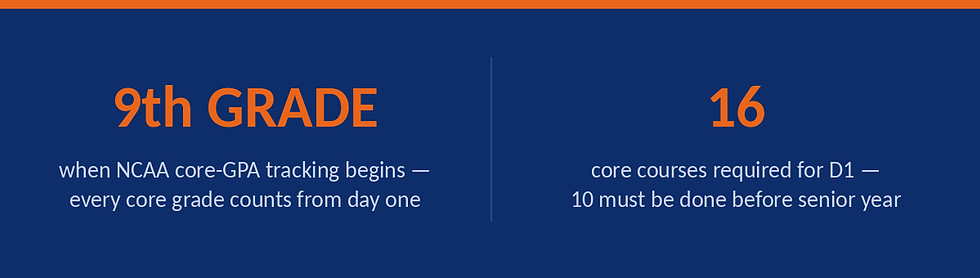
Freshman year of high school feels like an arrival — finally in the building where the big things happen. And for student athletes with college ambitions, freshman year is in fact the most structurally important year of the entire recruiting journey. Not because coaches are watching (most are not yet), but because this is when the clock starts. The NCAA begins tracking your core GPA on the first day of 9th grade. Every core course grade from this point forward contributes to the academic record that determines whether you are eligible to receive a scholarship at all.
What follows is not a list of aspirations. It is a practical, action-oriented checklist built around the actual decisions, registrations, and habits that determine recruiting outcomes four years later.
The Non-Negotiables: Do These Before Winter Break
1. Register With the NCAA Eligibility Center
Go to eligibilitycenter.org and create an Academic and Athletics Certification account — the paid account required for Division I and II. Submit a request for your high school to send an official transcript. This registration does not mean you have been contacted by colleges — it means you are in the system. Waiting until junior year to do this creates dangerous delays. Cost: $110 for U.S. students (fee waivers are available for qualifying families).
2. Map Your 16 Core Courses With Your Counselor
Sit down with your high school counselor and map every semester of high school against the 16 required NCAA core courses. Print your school's approved list from the Eligibility Center and confirm every required course is covered. D1 requires: 4 English, 3 Math (Algebra I or higher), 2 Natural/Physical Science, 1 additional English/Math/Science, 2 Social Studies, 4 additional core courses. If your school is missing any, identify alternatives now — not junior year.
3. Set a GPA Target and Track It Every Quarter
The D1 minimum is a 2.3 GPA in your 16 NCAA core courses — and since 2023, no SAT or ACT score is required for NCAA eligibility. But realistically, competitive D1 programs recruit athletes averaging 3.2 to 3.7. Set your target based on the division level you are pursuing, and review your grade report every quarter — not every semester. A bad semester can be partially recovered. A bad year is much harder. Your athlete's core GPA should live in a spreadsheet that both the athlete and parent can see at any time.
Building Your Recruiting Foundation in 9th Grade
While the academic infrastructure is the most critical freshman year task, recruiting foundation-building runs in parallel. Coaches cannot officially contact most athletes until after sophomore year — but they are watching long before that. Here is how to be visible in the right ways.
Athletic Development
Join your school's varsity or junior varsity program and a competitive club team. The club team is where most college coaches do their initial scouting — it provides more concentrated competition and more exposure events than a high school season alone. Begin building a highlight video library this season. Even if the footage is not yet ready for coach outreach, you need organized film from every season starting now. Three years of organized game footage produces a far better highlight tape than a frantic 3-month editing sprint in 11th grade.
Recruiting Awareness
Build a target school list this year — not next. Start with 30 to 50 schools across D1, D2, D3, and NAIA. Cast a wide net deliberately. The families who commit to one division level in 9th grade consistently produce worse outcomes than families who stay open across multiple levels while the picture clarifies. Follow 10 to 15 coaches at target schools on social media. Study their systems, their team culture, their recruiting language. This intelligence makes your eventual outreach emails 10 times more credible than generic form emails.
“Freshman year GPA is the one thing in this process that cannot be undone. You can improve, but you cannot erase. Start strong.”
The Freshman Email: Start Reaching Out Now
This surprises most families — but there is no rule preventing a freshman from emailing a college coach. The rule only governs when coaches can respond with official contact. Sending a professional, well-written introductory email in 9th grade does three things: it puts your athlete on a coach's radar early, it demonstrates maturity and initiative, and it practices a skill your athlete will need to execute hundreds of times over the next three years.
The email should be brief, specific, and written by the athlete. One paragraph about who they are athletically and academically, one sentence about why that specific school interests them (not generic — specific), and a link to whatever film exists. Close with contact information. That is it. No pressure, no ask for anything. Just introduction and visibility.
The Test Score Timeline
Since 2023, the SAT and ACT are no longer required for NCAA eligibility — but they still matter for college admissions and academic scholarship money at many schools. Most families wait until junior year to take the SAT or ACT. The athletes who score highest take their first test sophomore year, use the results to identify gaps, and have multiple test attempts completed before the beginning of junior year. Start SAT/ACT prep no later than the second semester of freshman year. Use Khan Academy's free SAT prep (official College Board partnership) as a starting baseline.
Parent Responsibility in Freshman Year
Your job in 9th grade is systems and awareness — not recruiting. The athlete should be sending emails, asking coaches questions, and owning the communication process from day one. Your job is to ensure the infrastructure is in place: the Eligibility Center account is registered, the transcript is submitted, the core course plan is mapped, and the PSAT is scheduled for sophomore year.
One conversation every parent should have this year: a candid, low-stakes conversation about realistic division targets. This is not about limiting your athlete — it is about making sure the scholarship search is focused in productive directions. A student athlete with a 2.8 GPA and solid club-level ability has real scholarship opportunities — they are just more likely to be D2 and NAIA than Power Four D1. Knowing this in 9th grade allows a family to build a realistic, productive strategy. Finding out in 11th grade is a crisis.
Download the free GFR Grade-by-Grade Recruiting Roadmap and all four parent guides at goalfullride.com
Next — Week 4: How Coaches Evaluate Players: What They're Really Looking For When They Watch Film
© 2026 Goal Full Ride | For educational purposes only. NCAA rules subject to change.


Comments